The Appetite Appeal Protocol: Prompting High-Fidelity Viscosity and Surface Tension in AI Food Commercials
Traditional food styling relies on physical hacks like motor oil and glue. In AI filmmaking, we must translate these physical properties into precise prompt parameters. Discover Montagea's protocol for controlling viscosity, surface tension, and macro camera physics in AI food videos.
Food styling is traditionally a trade of illusions. To make a burger look fresh on camera, stylists paint it with motor oil; to make cereal look crisp, they float it on Elmer's glue. In the realm of AI filmmaking, however, these physical sleights of hand must be translated into precise prompt parameters that govern digital physics.
When generating commercial-grade food videos with advanced AI models, creators frequently hit a wall of synthetic textures—melted chocolate that behaves like liquid mercury, cheese pulls that dissolve into visual noise, and steam that looks like heavy smoke. At Montagea, we have developed a systematic prompting framework that treats generative AI models not as passive image generators, but as high-speed camera rigs paired with real-time fluid simulators. By mastering the physical variables of viscosity, surface tension, and thermodynamics, you can produce mouth-watering commercial assets that satisfy the highest industry standards.
The Physics of Appetite Appeal: Why AI Food Cinematography Fails (and How to Fix It)
Most AI-generated food videos fail because creators rely on subjective adjectives. Prompts like "cinematic food shot, delicious hamburger, ultra-realistic slow motion" provide no physical boundaries for the video model to calculate. Video diffusion models do not understand what makes food look appetizing; they only understand pattern distribution. When you prompt "melted chocolate," the AI pulls from a massive dataset that mixes patterns of mud, paint, and dark water. The result is often a flat, plastic-looking substance that lacks the specular highlights and natural flow of real chocolate.
To break through this uncanny valley, we must shift our vocabulary from aesthetic descriptions to prompt-engineered physics. This means defining the material's viscosity, surface tension, and thermodynamic state. Instead of asking for "delicious syrup," we must specify its density, how it clings to a surface, and how it refracts light under studio conditions. This is the core of digital food styling: instructing the AI to simulate physical properties rather than paint a generic picture.
At Montagea, our production methodology treats the AI video model as a high-speed camera rig—such as a Phantom Flex 4K running at 1000 frames per second—interacting with real-world fluid dynamics. By framing your prompts around camera mechanics and physical fluid simulation terms, you force the AI to render realistic weight, momentum, and light interaction, transforming a chaotic generation into a commercial-grade asset.
The Viscosity Matrix: Prompting Fluid Dynamics for Syrup, Cheese, and Oil
Controlling how liquids move is the most challenging aspect of AI food commercials. Low-viscosity fluids like milk or citrus juice behave erratically when slow-motion prompts are applied, often turning into atomic splashes that defy gravity. Conversely, high-viscosity fluids like honey or melted chocolate can easily lose their weight and flow like water. To solve this, we use a structured prompting framework called the Viscosity Matrix.
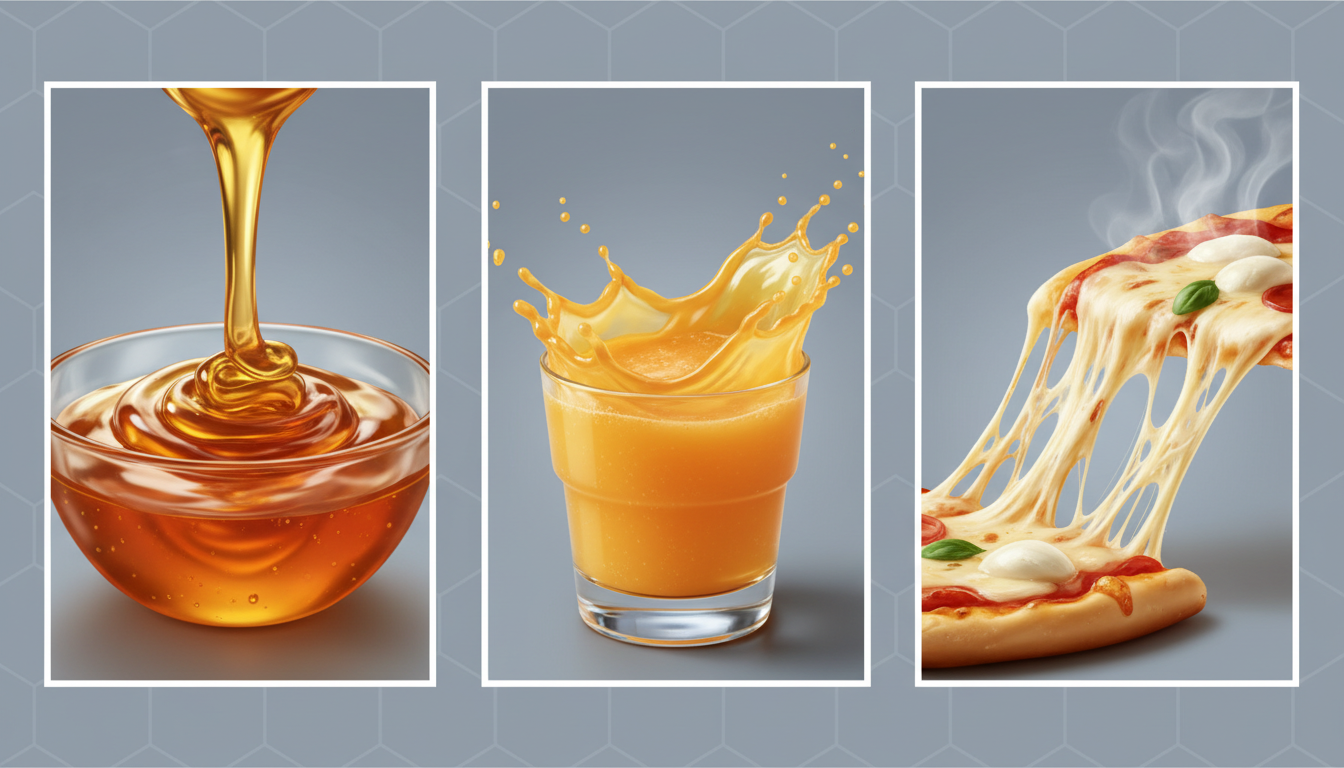
Surface tension modifiers are critical here. Without them, liquids won't cling to food surfaces realistically; they will slide off like digital mercury or clip through solid objects. By prompting specific contact angles, capillary action, and surface clinging, you tell the model to render the subtle friction that occurs when a liquid meets a solid surface.
| Fluid Type | Viscosity Class | Key Physical Prompt Modifiers | Sample Prompt Excerpt |
|---|---|---|---|
| Maple Syrup / Honey | High Viscosity | Slow-coiling ribbon, high surface tension, amber translucency, slow-motion viscous drag, specular highlights, clinging to porous surfaces. | "Thick amber maple syrup slowly pouring, forming a rich coiling ribbon on a pancake, high surface tension, slow-motion viscous drag." |
| Citrus Juice / Milk | Low Viscosity | High-velocity splash, micro-droplets, surface tension break, liquid cavitation, sharp specular reflections, rapid dispersion. | "A fresh orange juice splash, high-velocity micro-droplets, sharp specular reflections, liquid cavitation, 1000fps slow motion." |
| Olive Oil / Butter | Medium Viscosity | Glistening coat, low contact angle, hydrophobic sheen, slow-spreading golden liquid, high refractive index, warm specular bloom. | "Warm melted butter slowly spreading across a seared steak, low contact angle, glistening hydrophobic sheen, high refractive index." |
Solving the Cheese Pull: The Physics of Elasticity
The "cheese pull" is the ultimate test of any food styling pipeline. Standard prompts usually result in a bizarre visual glitch where the cheese instantly melts into a soup or stretches like rubber bands without any texture. To prompt a realistic cheese pull, you must break down the physical transition of the dairy fibers. Use terms that describe the structural breakdown: "fibrous dairy strands," "tensile stretching," "torn gluten network," and "elastic cheese pull with micro-tears."
Additionally, you must prompt the thermodynamic release that occurs during the pull. Specifying "steam venting from tiny pockets within the stretching cheese" forces the AI to render realistic micro-motion and texture along the pulling plane, preventing the cheese from looking like a solid, static 3D model.
Macro Camera Dynamics: Simulating Probe Lenses and High-Speed Rigs
In high-end food advertising, camera movement is just as important as the food itself. Directors use specialized equipment like the Laowa Probe lens to dive deep into ingredients, creating an immersive, larger-than-life perspective. Replicating this in AI requires prompting specific camera physics. You must describe a tight, linear push-in through elements rather than a generic zoom, which merely crops the image.
To master the fundamental physical rules of close-up generation, explore our deep dive on the physics of micro-scale macro shots. When prompting a probe lens effect, use terms like "probe lens perspective, linear camera glide, extreme close-up passing through fresh herbs, razor-thin depth of field, f/2.8 aperture, sharp focal plane shifting smoothly." This tells the model to maintain correct spatial proportions and blur the foreground and background realistically as the camera moves.
To take this a step further, you can simulate high-speed robotic camera sweeps, mimicking the motion of a Bolt cine robot. These sweeps combine high-speed camera movement with slow-motion physics. For a structured approach to prompting steady camera paths without visual drift, refer to our guide on kinetic tracking shots. By combining kinetic camera prompts with fluid dynamics, you can create a shot where the camera whips around a falling strawberry just as it hits a pool of cream, capturing the impact with perfect spatial coherence.
The Thermodynamic Stack: Prompting Steam, Sizzle, and Condensation
Appetite appeal is deeply tied to temperature. If a dish looks room temperature when it should be piping hot or ice cold, the illusion is shattered. We use the "Thermodynamic Stack" to prompt the precise micro-environmental cues that signal freshness, heat, and cold.
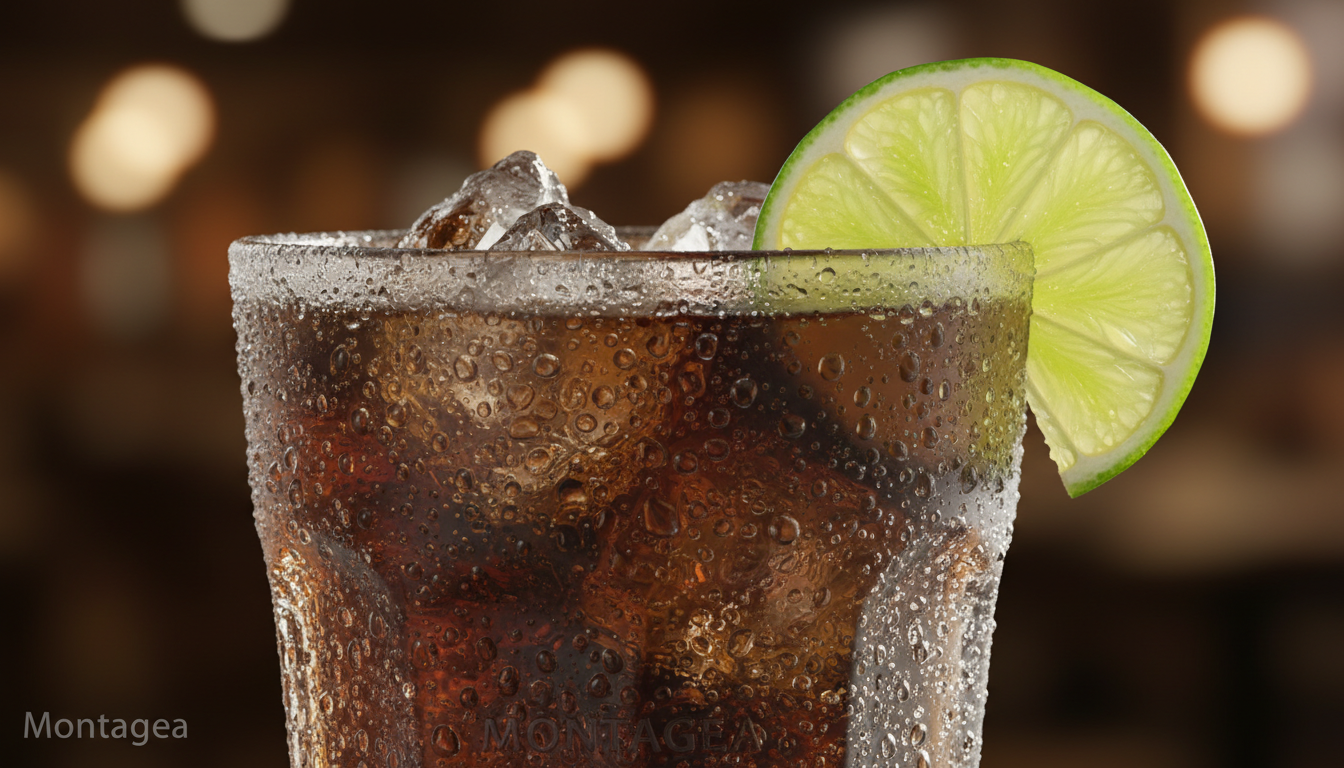
To simulate cold, focus on micro-condensation. Do not just prompt "cold glass." Instead, specify "beaded micro-condensation droplets with high refractive indices clinging to the frosted glass surface." This forces the AI to render the tiny, spherical shapes of water droplets that catch and bend the studio light, creating an instant sensation of crisp, refreshing cold.
When prompting heat, avoid the word "smoke," which often triggers the AI to render thick, dark plumes that look like a kitchen fire. Instead, prompt "wispy, low-density steam rising gently," "translucent thermal plumes," or "rapidly dissipating water vapor." This results in a delicate, atmospheric heat layer that enhances the food without obscuring it. For active cooking shots, prompt the "high-frequency micro-motion of sizzling oil" and "minor fat splatters popping on a hot skillet surface" to capture the energetic, sensory-rich physics of a live sear.
Chaining the Commercial: Assembling a Cohesive Food Spot
Once you have mastered individual macro shots, the next step is combining them into a cohesive 15-second commercial. A common pitfall in AI video generation is "style drift"—where the color grading, lighting, or food texture changes drastically from shot to shot. To prevent this, establish a strict visual and color grading baseline in your prompt prefix, specifying details like "warm studio lighting, 3200K color temperature, soft key light, dark moody background, shot on Arri Alexa."
When transitioning from tight macros to an overhead flat-lay of the entire table, you can deploy the nadir overhead perspective. This transition provides a perfect structural break in your commercial, moving the viewer from the intense, sensory-rich close-ups to a clean, graphic layout of the finished meal. To keep fluid pours flowing smoothly without sudden jumps or cuts, apply the principles of progressive shot extensions. This ensures that a syrup pour or a wine splash maintains its physical trajectory and velocity across extended runtimes.
Finally, never underestimate the power of sound design. Modern food commercials rely heavily on ASMR audio—the crisp crunch of a bite, the deep sizzle of a steak, or the thick gloop of honey. In AI filmmaking, high-fidelity sound design does more than set the mood; it actively masks minor visual imperfections. If a fluid splash has a minor rendering glitch, a crisp, synchronized audio splash will trick the human brain into perceiving the movement as entirely natural, locking in the realism of your digital food styling workflow.
How do I stop AI-generated food from looking plastic or fake?
To eliminate plastic textures, avoid generic aesthetic terms like "delicious" or "realistic." Instead, prompt the physical properties of the material. Use terms like "specular highlights," "subsurface scattering" (especially for meats and fruits), "porous surface texture," and "micro-imperfections." Specifying the lighting source, such as "diffused softbox studio lighting," also forces the AI to render realistic shadows and reflections rather than flat, synthetic surfaces.
What are the best prompts for realistic liquid splashes in AI video?
For realistic splashes, you must define the fluid's viscosity and camera speed. Use terms like "high-velocity splash," "liquid cavitation," "micro-droplets," and "surface tension break." Combine these with camera physics prompts such as "shot at 1000fps slow motion, Phantom Flex camera" to ensure the AI renders the splash as a heavy, physically accurate fluid rather than a chaotic mist.
How do I prompt a realistic cheese pull in AI?
A realistic cheese pull requires prompting elasticity and structural breakdown. Use precise terms like "fibrous dairy strands," "tensile stretching," "elastic cheese pull with micro-tears," and "torn gluten network." To add realism, prompt thermodynamic details such as "wispy steam venting from tiny air pockets within the stretching cheese." This prevents the cheese from looking like a solid, lifeless plastic block.
How do you simulate steam and heat in AI food commercials?
Avoid using the word "smoke," which causes AI models to generate dark, heavy plumes. Instead, prompt "wispy, low-density steam," "translucent thermal plumes," or "rapidly dissipating water vapor." For cooking shots, add "high-frequency micro-motion of sizzling oil" and "minor fat splatters popping on a hot skillet" to simulate the active physics of heat.