The Script-Splitting Protocol: How to Divide a Screenplay for Collaborative AI Video Production
Traditional script breakdowns rely on physical locations and actor schedules. In collaborative AI filmmaking, we must partition scripts by asset dependencies, prompt parameters, and model seed clusters to prevent stylistic drift and optimize compute budgets.
Traditional film production divides screenplays by physical logistics: locations, actor availability, and daylight hours. In AI filmmaking, however, these physical boundaries disappear, replaced by digital constraints like model consistency, seed parameters, and GPU render budgets. When multiple creators collaborate on a single AI-generated film, splitting a script by simple scene numbers or page counts is a recipe for visual chaos.
Without a structured framework, adjacent shots will suffer from jarring stylistic drift, fluctuating character faces, and mismatched lighting environments. This guide introduces the Script-Splitting Protocol, a production-tested methodology designed to partition screenplays by asset dependencies and generative pipelines rather than traditional logistics. By aligning your team around this workflow, you can generate cohesive films without overlapping efforts or visual dissonance.
The Physics of Collaborative AI Script-Splitting
In traditional filmmaking, an assistant director creates a script breakdown to optimize shooting schedules. Scenes are grouped by physical location to minimize "company moves"—the time-consuming process of packing up equipment, transport, and resetting lights. However, AI generation engines do not care about physical locations; they care about model consistency, seed parameters, and prompt syntax. In the virtual space, a company move occurs when you change your base model, LoRA weights, or style reference images.
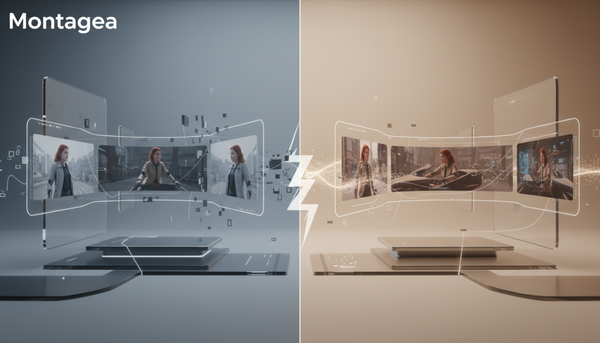
Splitting a script arbitrarily by page count or scene sequence leads to severe stylistic drift. If Creator A generates Scene 1 (a conversation on a city street) and Creator B generates Scene 2 (the continuation of that conversation from a reverse angle), the slight variations in their prompt structures, seed clusters, and model versions will break the visual continuity. Faces will shift subtly, clothing textures will morph, and the color temperature of the streetlights will fluctuate. This visual dissonance immediately pulls the audience out of the narrative.
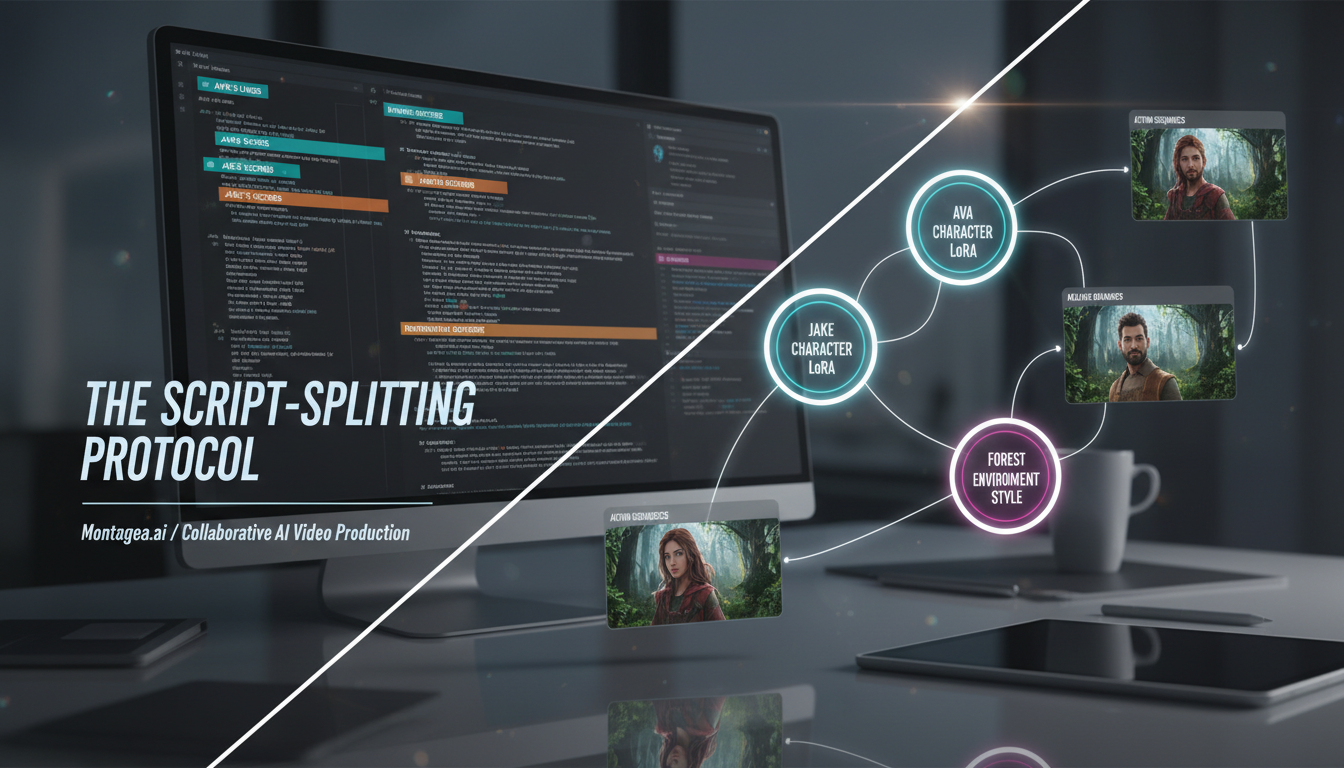
At Montagea, we advocate for a visual-first partitioning strategy that aligns script segments with specific model pipelines and generation engines rather than traditional page counts. Instead of assigning pages 1 to 5 to one artist and pages 6 to 10 to another, the script must be divided based on asset dependencies. This approach ensures that the creator who has optimized a specific character LoRA or environmental style reference (sref) handles all corresponding shots, regardless of where they fall in the timeline.
Furthermore, uncoordinated generation results in redundant rendering cycles and ballooning compute costs. Our guide on the Co-Generation Protocol outlines how to prevent asset redundancy and credit waste during collaborative sessions, ensuring that your team's collective computing budget is spent on unique, usable frames rather than repetitive trial-and-error. By treating GPU compute as a finite production resource, the Script-Splitting Protocol protects your budget while preserving visual integrity.
Three Frameworks for Dividing Your AI Screenplay
Depending on the narrative structure, visual complexity, and team size of your project, you should select a partitioning framework that minimizes hand-off friction. Rather than forcing every film into a single template, choose the framework that aligns with your primary production bottleneck—whether that is maintaining a character's face, preserving a complex environment, or managing high-action rendering pipelines.
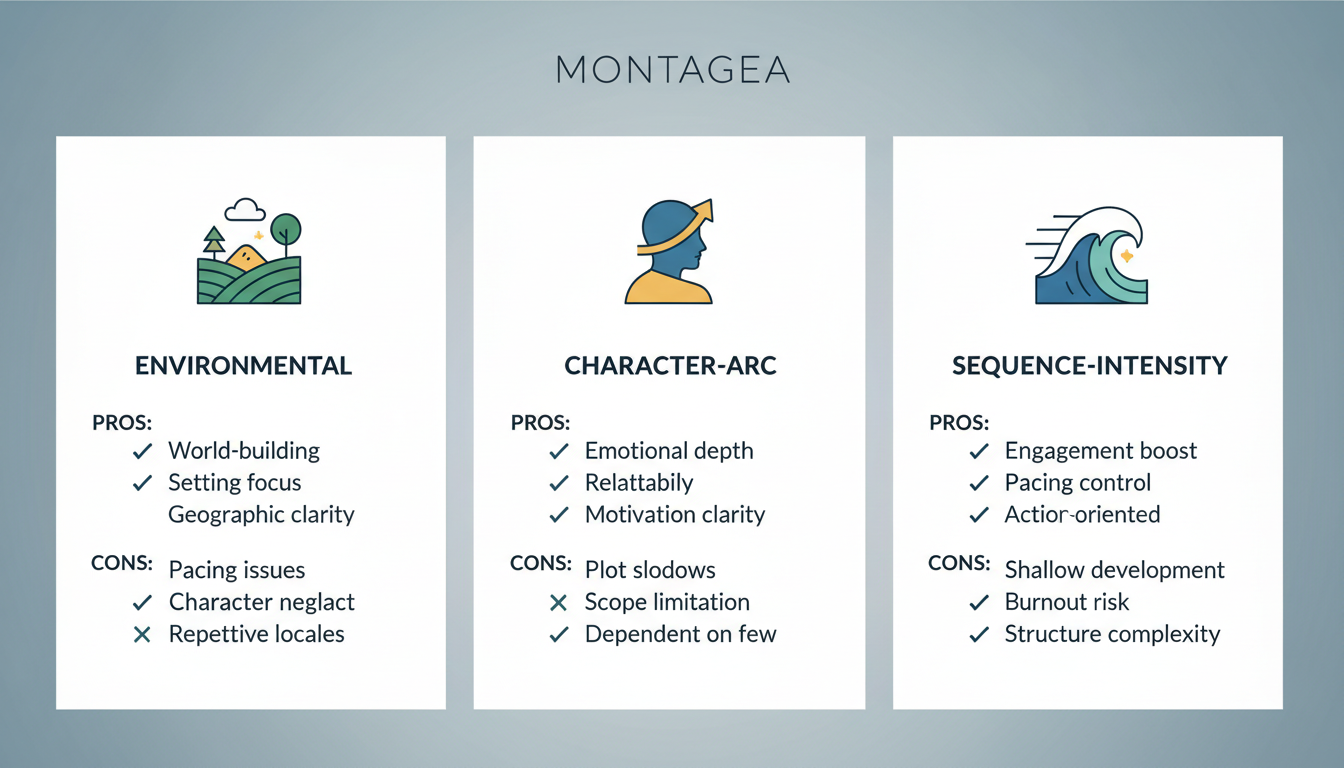
1. The Environmental Partition (Location-Based)
The Environmental Partition is best suited for world-building heavy films where environments dictate the generation seed. In this model, one creator owns the "desert wasteland" scenes, another owns the "neon cyberpunk city" scenes, and a third handles the "interior laboratory" sequences. Because the environment remains constant within each creator's assignment, they can lock in specific style reference (sref) codes and base seeds, ensuring perfect environmental continuity. The main challenge lies in passing characters between these environments, which requires strict adherence to shared character assets.
2. The Character-Arc Partition (Asset-Based)
For narrative-heavy projects with recurring actors and deep emotional arcs, the Character-Arc Partition is highly effective. In this setup, Creator A generates all shots featuring Character A, utilizing a highly trained, custom LoRA model that they have tuned for facial consistency and performance. Creator B does the same for Character B. When the script requires both characters to appear in the same frame, the creators either collaborate on a shared prompt or use compositing techniques in post-production to merge their respective character generations into a single shot.
3. The Sequence-Intensity Partition (Compute-Based)
The Sequence-Intensity Partition is designed for action-heavy films where shot complexity varies wildly. Dialogue-driven, slow-paced scenes require subtle micro-expressions and minimal physical movement, which can be handled efficiently with standard video generation models. Conversely, high-speed chase scenes, explosions, and complex physics simulations require advanced motion brush control, higher frame rates, and extensive post-generation upscaling. Under this framework, your most experienced technical artists handle the high-intensity action sequences, while other team members focus on the dialogue and transition shots.
| Framework | Best For | Primary Advantage | Key Challenge | Recommended Team Size |
|---|---|---|---|---|
| Environmental | Sci-fi, fantasy, world-building heavy projects | Flawless world consistency and lighting coherence | Managing character hand-offs between environments | 3 to 5 creators |
| Character-Arc | Dramas, character studies, dialogue-driven films | Unmatched facial and wardrobe consistency | Compositing two characters into the same frame | 2 to 3 creators |
| Sequence-Intensity | Action, thriller, VFX-heavy blockbusters | Optimized compute budget and motion quality | Maintaining stylistic unity across different motion densities | 4+ creators |
Setting Up the Shared Asset Bible Before Generation
Before a single prompt is run, collaborative teams must align their tools, syntax, and visual assets. Skipping this step guarantees that the final edit will look like an anthology of unrelated short clips rather than a unified film. The Shared Asset Bible serves as the single source of truth for every creator on the project, locking down the exact parameters of the visual universe.
The first step is establishing a Master Prompt Syntax. This is not just a list of keywords, but a structured template that dictates how prompts must be ordered. For example, your team might agree on a syntax like: [Shot Type] + [Subject Details] + [Environment] + [Lighting Style] + [Camera Lens/Movement] --sref [Code] --cref [URL]. By standardizing the order of prompt elements, you ensure that the AI model weighs stylistic inputs consistently across different creators' accounts. A shared dictionary of lighting terms (e.g., "low-key volumetric lighting, 3200K color temperature") prevents one creator from rendering crisp, cool daylight while another renders hazy, warm golden hour tones.
Next, the team must build a Shared Seed Registry. This registry documents verified style reference (sref) codes, character reference (cref) source images, and base seed numbers that have yielded high-quality results during the pre-production testing phase. When a creator is assigned a scene, they pull the exact assets and parameters from this registry, eliminating the need to guess or regenerate shots from scratch. Before splitting prompts, establish a unified cinematic AI storyboarding pipeline to lock down camera angles and pacing. Laying out the visual blueprint of the script in advance ensures that camera heights, focal lengths, and spatial relationships are locked in before high-fidelity generation begins.
Managing the Hand-Off and Shot Integration
The true test of the Script-Splitting Protocol occurs during the hand-off phases—the moments in the film where the narrative transitions from one creator's assigned segment to another's. To prevent sudden visual shifts, implement the "Overlapping Shot" rule. Under this rule, creators do not stop generating precisely at the boundary of their assigned scenes. Instead, they are required to generate transitional shots that bridge their respective segments using shared assets. This provides the editor with "handles"—extra frames at the beginning and end of clips—to execute seamless cuts and dissolves.
To maintain a coherent sense of depth across distinct environmental shots, ensure all creators apply the Split-Plane Protocol to maintain true cinematic parallax across different environmental shots. This technique ensures that background elements, midground subjects, and foreground framing maintain consistent relative speeds during camera moves, preventing the flat, artificial "cardboard cutout" look that often plagues AI-generated video.
In post-production, use a unified color grading template (LUT), uniform film grain overlays, and consistent depth-of-field adjustments to mask any remaining subtle stylistic differences between creators. A shared grain pass acts as a visual glue, binding disparate textures and compression artifacts into a single, cohesive cinematic texture. Finally, establish a structured feedback loop to handle revisions. When integrating shots, directors must give precise feedback rather than vague notes. To streamline this process, apply the Director's Translation Protocol for translating creative feedback into technical prompt adjustments. This ensures that notes like "make this scene feel more dramatic" are translated into actionable prompt modifications, such as adjusting the volumetric lighting values or camera angles, saving valuable render credits and production time.
How do you maintain character consistency when two different creators are generating shots for the same film?
To maintain character consistency across different creators, you must establish a Shared Seed Registry and use identical character reference (cref) images or custom-trained LoRA models. Both creators must use the exact same base model, trigger words, and prompt syntax structure for the character, ensuring their face, hair, and wardrobe remain visually identical throughout the film.
Should we split our AI film script by scene numbers or by character appearances?
For AI filmmaking, splitting by character appearances (Character-Arc Partition) or environments (Environmental Partition) is far more effective than splitting by linear scene numbers. Linear splitting causes stylistic drift, whereas asset-based splitting allows a single creator to maintain deep visual consistency for a specific character or setting before passing the shots to the editor.
How can a collaborative AI film team avoid wasting GPU credits on redundant generations?
Teams can prevent credit waste by implementing the Co-Generation Protocol, establishing a Master Prompt Syntax, and locking down camera angles via a storyboarding pipeline before initiating high-fidelity renders. This ensures that every generated shot has a clear, pre-visualized purpose in the final edit, eliminating trial-and-error prompting.
What is the best way to handle transitions between scenes generated by different team members?
Use the "Overlapping Shot" rule, requiring creators to generate handle frames that extend slightly past their assigned scene boundaries. In post-production, unify the segments using a shared color grading LUT, a consistent film grain overlay, and depth-of-field adjustments to blend any subtle visual variances seamlessly.