The Liquid & Glass Protocol: A Professional AI Workflow for Luxury Perfume Commercials
Creating luxury perfume commercials requires mastering the chaotic physics of glass refraction, liquid viscosity, and elegant human interaction. The Liquid & Glass Protocol offers a professional, multi-engine AI pipeline designed to deliver photorealistic, high-end commercial results.
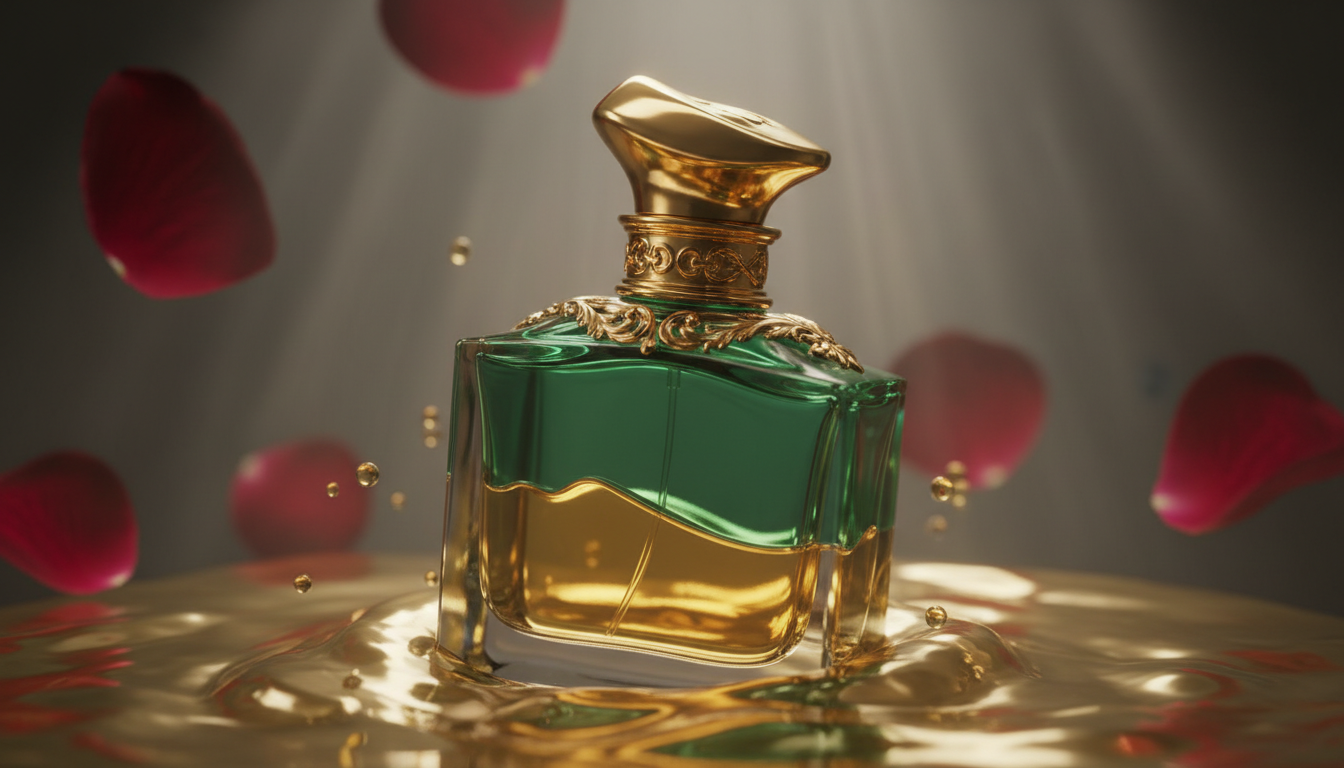
Luxury perfume campaigns have never been about selling a physical liquid; they sell an intangible atmosphere, a sensory memory, and an aspirational lifestyle. Historically, capturing this on film required million-dollar budgets, high-speed motion control rigs, phantom cameras, and specialized SFX teams managing complex fluid dynamics and optical refractions. For independent filmmakers and boutique agencies, matching this level of cinematic polish was once cost-prohibitive.
As AI filmmaking matures, directors are moving beyond generic, chaotic generations toward highly controlled, commercially viable pipelines. At Montagea, we have formalized this transition with the Liquid & Glass Protocol—a rigorous, multi-model production framework designed specifically to solve the hardest physical simulation challenges in luxury product rendering: glass caustics, realistic fluid viscosity, and seamless human-object interaction. By treating AI as a precise orchestration tool rather than a one-click generator, this protocol allows creators to execute high-fashion spec commercials that rival traditional studio productions.
The Sensory Challenge of Virtual Scent: Why Perfume Ads Demand Advanced AI Orchestration
Traditional perfume ads rely on high-budget cinematography, macro lenses, and complex SFX rigs to capture liquid dynamics and glass refractions. In the physical world, a director uses specialized lighting to coax beautiful, dancing caustics out of a molded glass bottle while high-speed cameras capture the slow-motion explosion of a liquid droplet. Because perfume is invisible, these hyper-detailed physical textures serve as visual stand-ins for scent, conveying notes of warmth, freshness, or decadence through visual weight and motion.
AI-generated commercial workflows must move past generic prompts to control specific physical simulations—such as viscosity, light caustics, and surface tension. Standard text-to-video models often fail here; they tend to treat glass as plastic, turn liquids into formless digital noise, and ignore the laws of optics. A simple prompt like "perfume bottle with liquid splashing" usually results in a generic bottle that morphs mid-shot, surrounded by water that lacks realistic weight or light dispersion.
Montagea's approach to luxury spec ads emphasizes a hybrid pipeline, combining precise spatial layouts with advanced temporal control to match the standards of high-end fashion houses. By separating the production process into distinct, controllable layers—first mastering the static product geometry, then simulating the fluid physics, and finally choreographing the human interaction—directors can maintain absolute creative control over every frame.
Step 1: Architecting the Hero Bottle with Flawless Glass and Fluid Dynamics
The foundation of any luxury commercial is the product itself. In AI filmmaking, you cannot rely on a video generator to create both a beautiful, consistent bottle design and realistic motion simultaneously. Doing so introduces too many variables, causing the brand identity to warp and shift from shot to shot. Instead, the workflow begins with establishing a master product design using high-resolution image diffusion models like Midjourney v6 or Stable Diffusion XL.
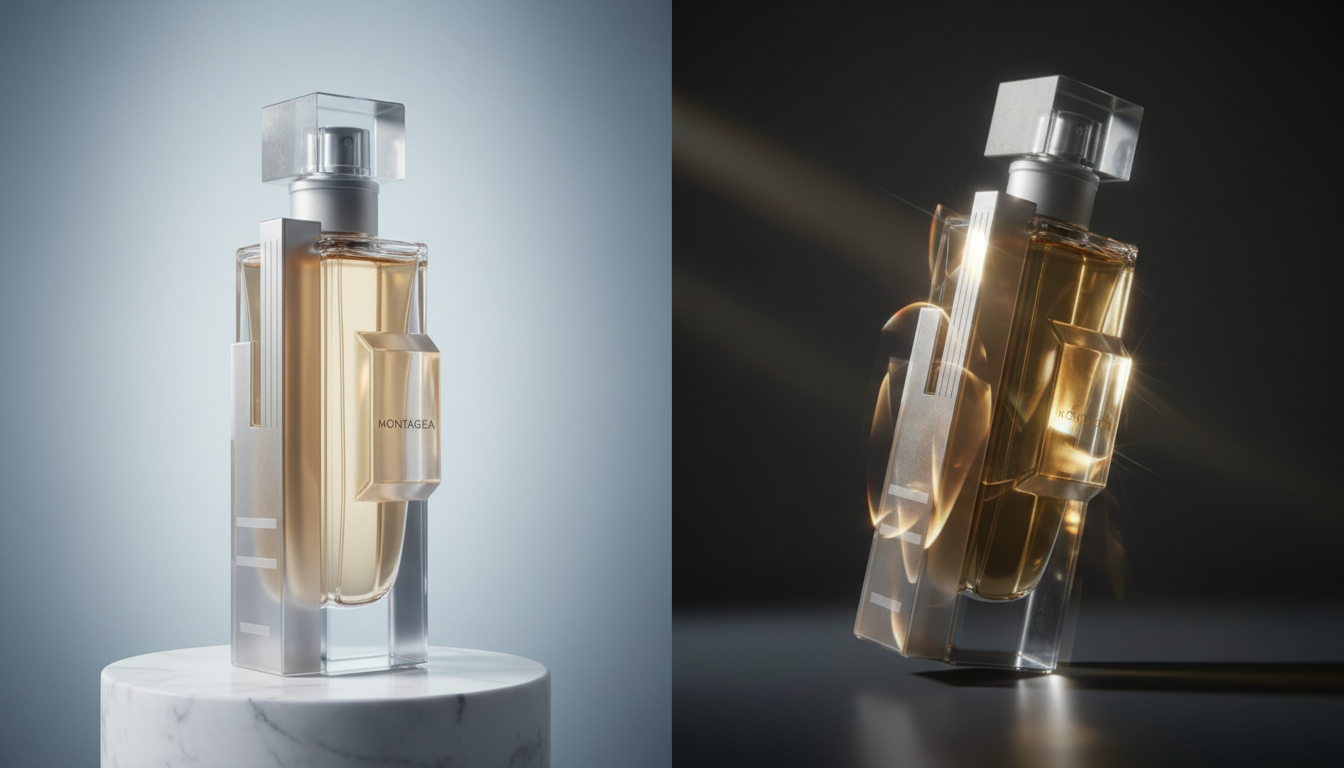
When generating the master bottle, your prompts must focus on high-end industrial design, materials, and studio lighting. Specify geometric symmetry, heavy glass bases, embossed metallic labeling, and precise physical properties. To resolve the notorious "glass-on-glass" problem—where AI struggles to render light passing through multiple transparent surfaces—your prompt must explicitly dictate how light behaves. Use technical terminology such as Fresnel refraction, caustic light patterns, dielectric boundaries, and double-walled glass reflections. This forces the model to calculate the complex bending of light through both the bottle's outer shell and the liquid inside.

Once you have generated a flawless, symmetrical master bottle, the next challenge is transitioning from a static concept to dynamic motion without losing the brand's core identity. To maintain a unified luxury aesthetic across different generation platforms, creators should implement the principles of style matching across diverse engines. By feeding your high-resolution master image into advanced image-to-video engines (such as Runway Gen-3 or Luma Dream Machine) as a structural reference, you lock down the bottle's design while allowing the engine to animate only the surrounding environment and internal fluid.
Controlling the Flow: Simulating Viscosity and Refraction
Luxury liquids do not behave like tap water. They have weight, oiliness, and surface tension. To make an AI-generated perfume look expensive, you must carefully control its simulated viscosity. A premium eau de parfum should appear slightly thick, clinging to the inner glass walls or dispersing in an incredibly fine, atomized mist rather than a chaotic splash.
To achieve this, your motion prompting must avoid generic words like "splash" or "water." Instead, use highly descriptive sensory prompts that specify viscosity and lighting:
- For slow-motion, luxurious flow: Use phrases like "slow-motion macro shot of viscous amber liquid swirling inside heavy emerald glass, 1000fps, subsurface scattering, light caustics refracting through the fluid, golden flecks suspended in oil."
- For atomized sprays: Use phrases like "ultra-fine mist spray, micro-droplets exploding from a gold nozzle, backlit by warm volumetric studio light, high-speed photography, black background, sharp depth of field."
Additionally, leverage negative prompting and weight adjustments in your generation parameters. Negative prompts should include terms like "coarse water droplets, digital noise, low-quality physics, turbulent water splash, motion blur artifacts." This keeps the fluid simulations smooth, elegant, and optically convincing.
Step 2: Choreographing the Sensory Narrative and Camera Movement
Luxury commercials rarely rely on static shots; they use sweeping, highly controlled camera movements that emphasize the product's premium curves and facets. In traditional production, this is achieved using high-speed camera arms like the Bolt, which can execute identical, sub-millimeter camera paths at high speeds. In the AI pipeline, replicating this level of precision requires guiding the generation engine's spatial awareness.
For precise camera choreography that keeps the bottle perfectly centered, utilizing a spatial line art translation protocol is essential. By feeding simple 3D wireframe renders or basic hand-drawn camera paths into spatial control networks (like ControlNet or IP-Adapter structures within Stable Diffusion), you can dictate exact camera behaviors—such as a 360-degree orbit, a dramatic macro sweep, or a vertical reveal—without letting the AI warp the bottle's geometry during the camera move.
Furthermore, perfume commercials often transition between the physical product and abstract sensory sequences that represent the scent profile—such as a blooming jasmine flower, exploding silk fabric, or a sudden rush of cold glacial water. Managing these complex transitions requires absolute control over the starting and ending states, which can be achieved through a precise first and last frame workflow. By anchoring the beginning of a sequence to the physical perfume bottle and the end to an abstract sensory explosion, you force the AI engine to generate a seamless, morphing transition that feels intentional and high-end rather than a jarring jump cut.
Step 3: Managing the Human Element: Elegance, Hands, and Skin Textures
Nothing breaks the illusion of a luxury commercial faster than poorly rendered human elements. The interaction between a high-fashion model and the perfume bottle is critical. In AI video generation, this introduces two major failure points: the "hero grip" (where hands hold highly reflective, complex glass objects) and the rendering of realistic, high-fashion skin textures under dramatic studio lighting.
When a model holds a bottle, AI engines often struggle to understand where the hand ends and the glass begins, resulting in warped fingers, floating bottles, or hands that melt into the product. To prevent distracting deformities when a model interacts with the bottle, production teams should deploy an anatomical anchor protocol to lock in realistic hands. This involves using a static, highly detailed reference image of a hand holding a physical prop of similar dimensions, then using inpainting and depth-guided control to swap the prop with the AI-generated luxury bottle while preserving flawless hand anatomy.

For skin textures and facial expressions, avoid over-prompeting with generic words like "beautiful" or "perfect," which often yield plastic, uncanny-valley results. Instead, prompt for specific photographic and lighting conditions: "high-fashion editorial photography, natural skin pores, subtle neutral expression, dramatic Chiaroscuro studio lighting, soft key light, sharp focus on eyelashes, 35mm lens, cinematic color grading." This ensures the model's face retains realistic texture, depth, and elegance under the intense, stylized lighting required for luxury branding.
The Perfume Commercial Pipeline: A Step-by-Step Production Framework
To execute this protocol successfully, production teams must utilize a structured multi-engine pipeline. The table below outlines the recommended tools, prompt structures, and settings for each stage of a luxury perfume commercial campaign.
| Production Stage | Primary AI Engine | Key Parameters & Prompt Modifiers | Deliverable Goal |
|---|---|---|---|
| 1. Concept & Bottle Design | Midjourney v6 / SDXL | --ar 16:9, "heavy emerald glass, Fresnel refraction, luxury branding, studio lighting" | High-resolution, symmetrical master product image. |
| 2. Fluid & Viscosity Simulation | Runway Gen-3 / Kling AI | Motion: 6, "viscous golden oil swirling, subsurface scattering, slow-motion 1000fps" | Realistic liquid motion inside and around the bottle. |
| 3. Camera Choreography | Luma Dream Machine / ControlNet | Depth-map guidance, "slow 360-degree orbit camera, macro zoom, locked focus" | Consistent camera sweeps without product warping. |
| 4. Human Interaction | Stable Diffusion Inpainting / Kling | Anatomical anchors, "elegant hand holding glass bottle, natural skin pores, soft key light" | Flawless hand-to-product contact and high-fashion modeling shots. |
| 5. Compositing & Color | DaVinci Resolve / Premiere Pro | Masking, tracking, luxury LUTs (champagne, deep emerald, rich gold tones) | Final editorial commercial export with consistent color grade. |
The Pre-Render Quality Checklist
Before exporting your final commercial sequence, run through this pre-render checklist to ensure your shots meet high-fashion broadcast standards:
- Geometric Consistency: Does the perfume bottle's logo, cap shape, and glass thickness remain identical across all sequential shots?
- Refraction Realism: Does the light passing through the glass bend realistically, or are there digital artifacts causing the background to warp unnaturally?
- Viscosity Match: Does the liquid's movement speed match the camera's frame rate? (e.g., a slow-motion sweep must feature slow-moving, high-viscosity droplets, not rapid water splashes).
- Anatomical Integrity: Are the model's fingers completely locked to the physical boundaries of the bottle during interaction shots, with zero clipping or extra digits?
- Lighting Coherence: Does the direction of the key light on the model's face match the highlights and caustics reflecting off the glass bottle?
By adhering to the Liquid & Glass Protocol, filmmakers can leverage the speed of generative AI while retaining the meticulous, high-end control that luxury brands demand. The future of commercial production lies not in letting AI make all the creative decisions, but in using robust, multi-engine pipelines to bring precise, sensory-rich visions to life.
How do you keep the perfume bottle design consistent across different AI video shots?
To maintain bottle consistency, generate a high-resolution master image first using Midjourney or SDXL. Use this image as a structural reference (image-to-image or IP-Adapter) in your video generator. To prevent the bottle from warping during camera movements, use spatial line art protocols or depth maps to lock the bottle's physical geometry in place while animating only the camera and environment.
What is the best AI video generator for realistic liquid and glass refraction?
Runway Gen-3 Alpha and Kling AI currently lead the industry in handling complex physical simulations like liquid viscosity and glass refractions. However, achieving high-end results requires precise prompting—such as specifying "subsurface scattering" and "Fresnel refraction"—along with negative prompts to eliminate water-like digital noise.
How do you prevent warped fingers when a model holds a perfume bottle in AI video?
Warped fingers are prevented by utilizing an anatomical anchor protocol. This involves using a real-world reference image or a 3D model of a hand holding a generic prop of the same size. By applying depth-guided control networks or inpainting, you can swap the generic prop with the high-end AI bottle, keeping the hand's anatomy mathematically locked and realistic.
Can AI video replace traditional 3D CGI for high-end product commercials?
AI video is not a complete replacement but rather a powerful companion to traditional 3D CGI. While CGI offers absolute, pixel-perfect control over geometry, AI excels at generating complex, organic physical behaviors—such as swirling liquids, volumetric light, and atmospheric textures—in a fraction of the time. The most advanced workflows combine basic 3D block-outs with AI style-transfer and simulation layers.