Private vs. Uncensored AI: Key Differences for Creative Workflows
Creative professionals often conflate data privacy with a lack of content filtering. Learn how these two distinct properties affect your intellectual property and artistic freedom.
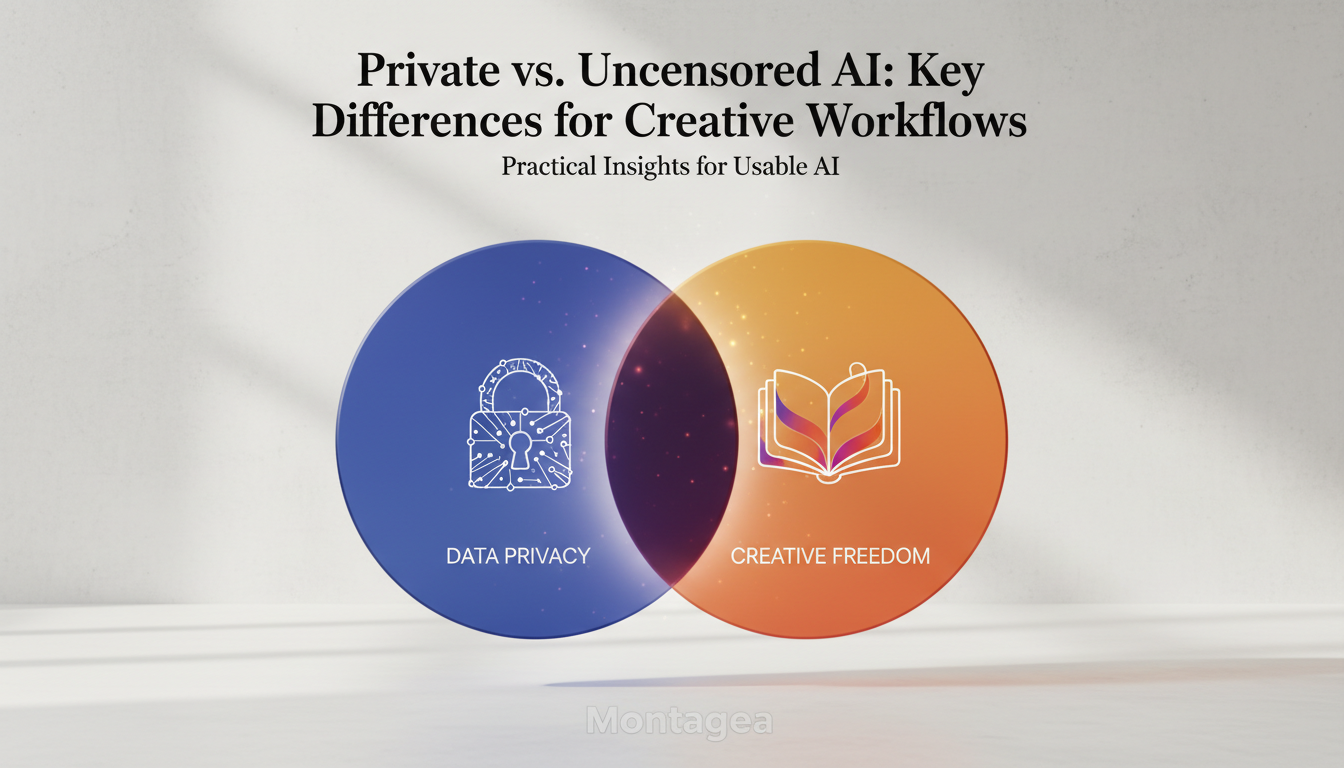
Private AI and uncensored AI address two completely different challenges in creative production: data security and content restrictions. While private AI ensures your prompts, assets, and intellectual property are never logged or used to train public models, uncensored AI removes system-level safety filters so you can generate sensitive, dramatic, or complex creative content without artificial refusals. Understanding this distinction is critical for creative professionals who need to protect proprietary client assets while maintaining complete artistic control over their stories.
The Core Distinction: Data Security vs. Content Freedom
Creative teams often conflate 'private' with 'uncensored' because both offer an alternative to mainstream corporate AI limitations. However, they solve entirely different problems. A system's level of privacy dictates who has access to your data, while its level of censoring dictates what kind of content you can generate.
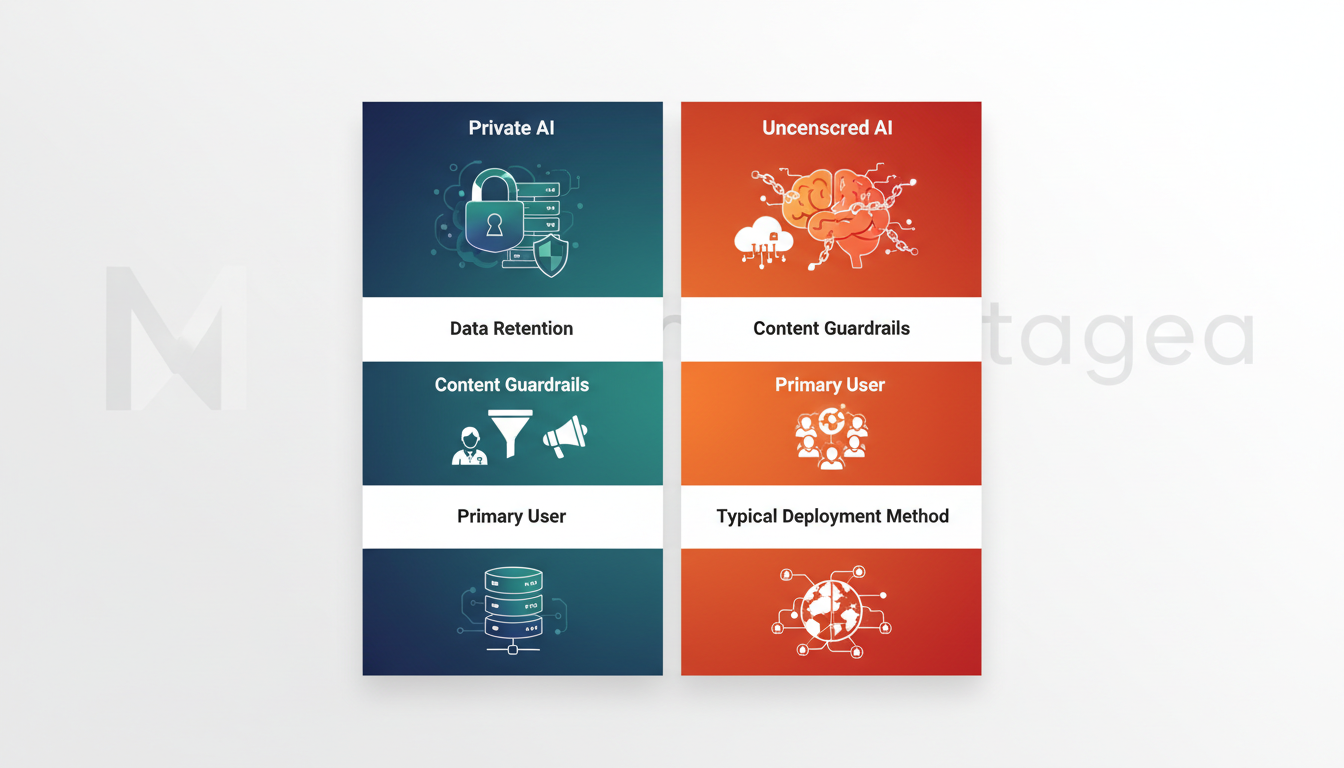
- Private AI: Focuses on data governance, local hosting, zero-retention policies, and preventing proprietary prompts or assets from being used for model training. The primary goal is intellectual property protection.
- Uncensored AI: Focuses on the removal of system-level safety guardrails, allowing the model to generate controversial, sensitive, or highly specific creative content without refusal. The primary goal is absolute creative freedom.
These two properties can diverge completely. For example, an enterprise deployment of a commercial model like GPT-4 can be highly private (with strict zero-retention APIs and custom data agreements) but remains heavily censored. Conversely, a free, web-hosted open-weight model might be completely uncensored—allowing you to write gritty crime noir dialogue—but highly non-private, logging every prompt you type to train future models.
Private AI: Protecting Intellectual Property and Client Assets
For commercial creators, data privacy is not a luxury; it is a contractual obligation. When working on unreleased films, proprietary advertising campaigns, or sensitive client briefs, uploading raw assets to standard consumer AI portals introduces severe legal risks. If an AI vendor logs your inputs, your client's intellectual property could theoretically influence future model outputs or be exposed in data leaks.
To mitigate this, professional workflows rely on two main deployment methods:
- Local Offline Execution: Running open-weight models locally on dedicated hardware (such as workstation GPUs). Because the data never leaves your physical machine, this represents the highest tier of privacy.
- Secure Cloud Endpoints: Utilizing APIs with explicit Zero-Data-Retention (ZDR) agreements. Under these contracts, the hosting provider processes your data but is legally barred from saving it or using it for training.
For teams looking to balance security with powerful cloud-based generation, you can explore our analysis of the best Venice AI alternatives for private and multi-model creative workflows. These platforms allow you to maintain tight control over your prompt data while still accessing high-performance creative models.
Uncensored AI: Bypassing Safety Filters for Complex Storytelling
Standard commercial AI models are heavily aligned to avoid controversy, but their safety filters are often over-sensitive. This creates severe bottlenecks for creative writers and filmmakers. A standard model might refuse to write a historical screenplay about World War II because the prompt contains words like 'bombardment,' 'artillery,' or 'conspiracy.' It might refuse to draft a dramatic scene depicting a heated argument, a corporate betrayal, or a medical emergency, misinterpreting these standard narrative devices as real-world threats or harassment.
Uncensored or unfiltered models—often created by fine-tuning open-weight models like Llama or Mistral to strip away alignment layers—solve this issue. They treat the user as the ultimate authority, executing prompts exactly as written. This allows screenwriters to draft authentic dialogue, explore dark themes, and build complex, conflict-driven narratives without constant refusal messages.
However, using these models demands professional responsibility. Creators must establish their own internal compliance checks to ensure that while the creative process is unfiltered, the final public-facing assets comply with copyright, safety, and distribution standards. To implement these guardrails yourself, you can learn how to safely integrate unfiltered AI into your creative workflows.
How to Choose: A Decision Matrix for Creative Production
Choosing the right setup depends on your project's security requirements and narrative complexity. Often, the ideal solution is a hybrid approach. For example, you can run an uncensored open-weight model on a local, air-gapped machine to achieve the ultimate private and unfiltered environment.
| Criterion | Private AI (Censored) | Uncensored AI (Public API) | Local Hybrid (Private & Uncensored) |
|---|---|---|---|
| Data Ownership | Dependent on API terms or local configuration | Risk of logging/training use | Stored locally on physical hardware |
| Prompt Restrictions | High (strict standard safety filters) | None (fully unfiltered) | None (fully unfiltered) |
| Hardware Requirements | Low (runs on cloud APIs) | Low (runs on cloud APIs) | High (requires powerful local GPUs) |
| Best Use Case | Commercial client work with clean content | Drafting complex, gritty creative scripts | Highly sensitive, unfiltered storytelling |
In modern production, managing these disparate systems can quickly become overwhelming. This is where Montagea provides a distinct advantage. As an AI creative agent, Montagea (powered by Gigi) helps creators orchestrate the best model for the job. When you describe a project—such as an ad, a short film, a poster, or a song—Gigi picks the best AI models, plans every step, and delivers the finished piece. For example, when evaluating video production capabilities, understanding how these models handle prompts is key; you can see how this works in practice by reading our guide on can ChatGPT make videos? to see how standard models compare to dedicated production pipelines.
By treating privacy and content filtering as distinct parameters rather than a single choice, creative teams can build a workflow that respects both their clients' intellectual property and their own artistic freedom.
Does using an uncensored AI model mean my data is automatically private?
No. Uncensored simply means the model does not have content safety filters. If you access an uncensored model through a free or public web interface, your prompts and generated content may still be logged, stored, and used to train future models by the hosting provider. To ensure privacy, you must run the uncensored model locally or use an API with an explicit Zero-Data-Retention (ZDR) agreement.
Can I run a private, uncensored AI model on a standard consumer laptop?
It depends on the model's size. Smaller open-weight models (such as 7-billion or 8-billion parameter models) can run reasonably well on modern consumer laptops equipped with at least 16GB of unified memory or a dedicated GPU. However, larger, production-grade models (like 70-billion parameter models) require high-end workstation GPUs with substantial VRAM to run at usable speeds.
Are there legal risks to using uncensored AI models for commercial projects?
The primary legal risks do not stem from the model being uncensored, but rather from the final output. If an uncensored model generates copyrighted material, trademarked assets, or defamatory content, your business is liable once that content is published. Commercial creators must implement their own editorial and legal clearance workflows before distributing any AI-generated assets.