
Image-to-Video vs. Text-to-Video for Product Ads: Choosing the Right Modality
Choosing between image-to-video and text-to-video is a balance of brand safety and creative scale. Discover how to deploy both modalities in a high-conversion ad campaign.

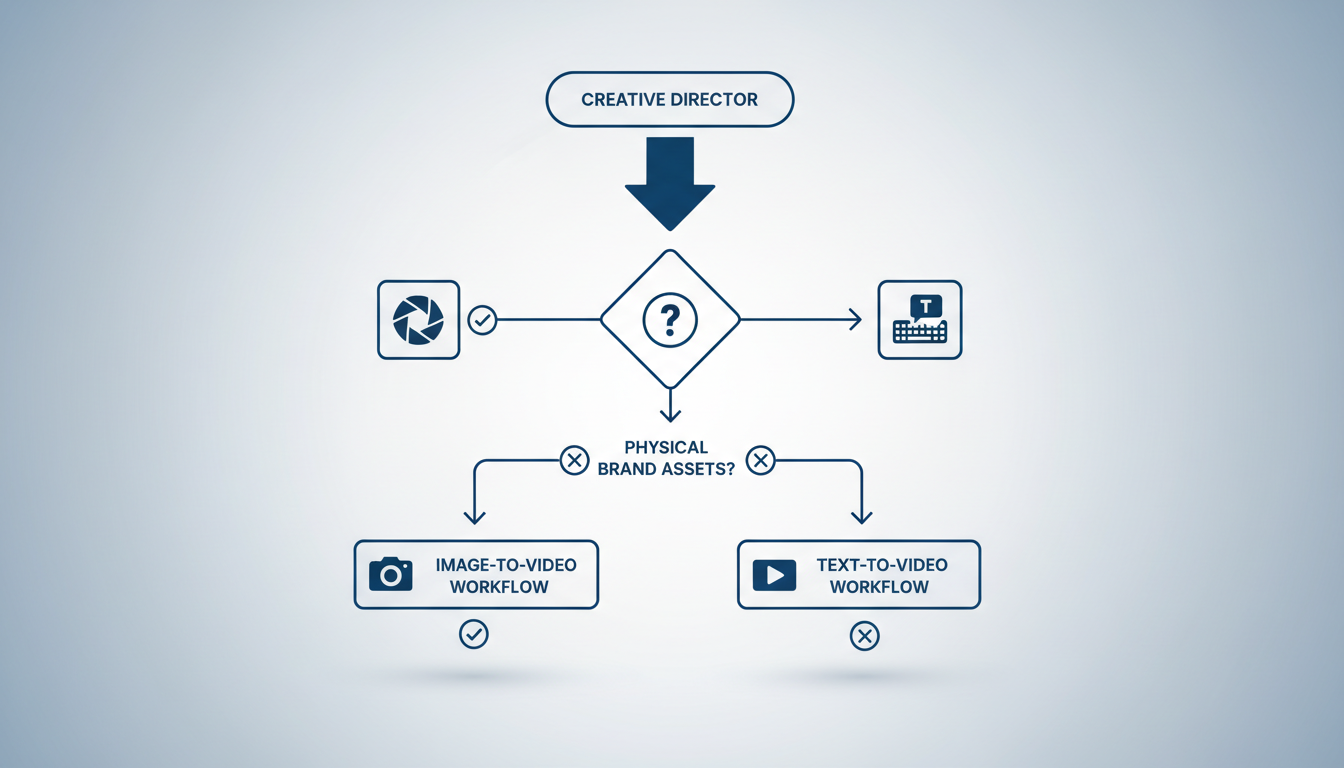
For product marketers and video producers, choosing between image-to-video (I2V) and text-to-video (T2V) comes down to a fundamental balance of brand safety versus creative scale. Image-to-video is often preferred when physical product accuracy, label text, and brand geometry must remain highly consistent. Conversely, text-to-video excels at generating conceptual backdrops, abstract transitions, and high-energy hooks where a specific physical asset is not yet required. High-conversion campaigns do not force a choice between the two; instead, they combine both within a unified, scene-by-scene production workflow.
The Core Tradeoff: Geometry Control vs. Conceptual Freedom
In commercial product advertising, visual fidelity is directly linked to consumer trust. A distorted logo, a warped bottle cap, or illegible ingredient text can instantly break the illusion of a premium product. This is where the core tradeoff between image-to-video and text-to-video becomes a critical strategic decision for creative directors.
Image-to-video (I2V) anchors the AI model's neural network with a high-resolution, pixel-perfect source image—typically a studio photograph or a 3D product render. Because the model has a concrete spatial reference, it can animate camera movements, lighting shifts, and environmental reflections while preserving the underlying geometry of the retail item. This makes I2V highly dependable for brand-safe placements.
Text-to-video (T2V), on the other hand, starts from pure digital noise. Guided only by text prompts, the engine must simultaneously invent the product, the setting, and the motion dynamics. While this unconstrained generation offers immense creative freedom to cook up surreal landscapes, complex liquid physics, or abstract visual metaphors, it introduces high unpredictability. Text-to-video models frequently hallucinate text, blend packaging elements, or skew brand colors, making them unsuitable for close-up hero shots of specific retail goods.
When to Choose Image-to-Video (I2V) for Product Ads
Image-to-video is mandatory whenever the primary goal of the shot is product recognition. If the ad features close-ups, packaging reveals, or texture demonstrations where the consumer needs to identify the exact item they will see on store shelves, starting with a static image is the only viable path.
The primary technical challenge in generative AI video is legible text rendering. Even state-of-the-art models struggle to generate crisp typography from scratch. By feeding a high-resolution photo with pre-rendered, perfect typography into an I2V engine, you bypass this limitation. The model simply animates the pixels around the text, keeping the brand name intact.
To execute this successfully, creative teams must employ specific prompting strategies that prioritize structural integrity over chaotic motion. This methodology helps ensure that camera instructions do not warp the foreground product. Additionally, managing physics in high-fidelity engines requires careful parameter selection to control liquid splashes and camera sweeps around 3D products.
When to Choose Text-to-Video (T2V) for Product Ads
While I2V is the anchor of product fidelity, text-to-video is the engine of visual hook generation. T2V is highly effective when you need to build dynamic, high-impact sequences that do not rely on an existing physical asset.
The first three seconds of a social media ad are critical for retention. Creators can use T2V to construct fast-paced, thumb-stopping visual sequences—such as a stylized explosion of botanical ingredients, a macro sweep of simulated silk, or a dramatic sci-fi environment.
T2V is also highly cost-effective for environmental storytelling. If your campaign requires a background plate of a volcanic black-sand beach or a slow-motion splash of organic honey, generating these environments via text prompts is significantly cheaper and faster than sourcing stock footage or organizing a physical shoot. Once the T2V background or transition is generated, it can be composited or sequenced alongside your hero product shots.
Comparison Matrix: Modality Selection by Campaign Goal
To help creative directors and video producers route their assets efficiently, this comparison matrix outlines how each modality performs across key production criteria:
| Production Criterion | Image-to-Video (I2V) | Text-to-Video (T2V) | Recommended Option |
|---|---|---|---|
| Brand Safety & Accuracy | High; designed to preserve logos, packaging geometry, and text. | Low; prone to text hallucination and product warping. | Image-to-Video (I2V) |
| Visual Variety & Scale | Medium; bounded by the composition of the source image. | High; can generate any environment, style, or camera angle. | Text-to-Video (T2V) |
| Asset Prep Time | Requires high-quality source photos or 3D renders. | Zero asset preparation; prompt-to-render pipeline. | Text-to-Video (T2V) |
| Motion Predictability | High; ideal for controlled camera pans, tilts, and orbits. | Low; physics and transitions can be chaotic or unpredictable. | Image-to-Video (I2V) |
The Hybrid Workflow: Building Multi-Scene Ads in Montagea
Rather than choosing one modality for an entire campaign, professional agencies build high-converting ads by blending both in a structured, scene-by-scene sequence. A standard 15-second social ad can be optimized by assigning the correct modality to each shot:
- Scene 1 (0-3s): The Hook (T2V) – A high-energy, abstract visual of ingredients exploding in slow motion to capture user attention.
- Scene 2 (3-10s): The Core Value (I2V) – A smooth, cinematic camera orbit around a high-resolution photo of the retail product, showing the label clearly.
- Scene 3 (10-15s): The Call to Action (Hybrid/End Card) – A clean graphic reveal with minimal motion to drive conversions.
Once the scenes are established, platforms like Montagea, which features the AI creative agent Gigi, can help generate these scenes from descriptions. Gigi can pick the best AI models, plan the steps, and deliver the finished pieces, or allow creators to select specific models themselves.
Using this approach, creators can run text-to-video generations for the opening hook scene using high-energy models, while focusing on running precise image-to-video renders of the product bottle for other shots. This split-scene approach helps balance brand asset consistency with the creative flexibility of generative AI.
How do I prevent product labels and logos from warping during an Image-to-Video generation?
To preserve labels, keep your motion prompts subtle and focused on camera movements (such as "slow camera orbit" or "gentle pan") rather than object-level transformations. Additionally, using negative prompts to discourage morphing and selecting advanced engines with strong spatial coherence will help maintain brand geometry.
Can I use Text-to-Video to generate a completely new product design for a pitch presentation?
Yes. Text-to-video is highly effective for rapid prototyping and conceptual pitch decks where exact product packaging does not yet exist. It allows you to quickly visualize aesthetic concepts, bottle shapes, and environmental contexts before investing in physical prototyping.
Which AI video engines are currently best suited for high-fidelity product physics?
Models like Kling and Hailuo H3 are among the options available for generating video content, each offering different strengths in motion and rendering. Choosing the right engine on a scene-by-scene basis is helpful for maintaining realism in commercial ads.



